
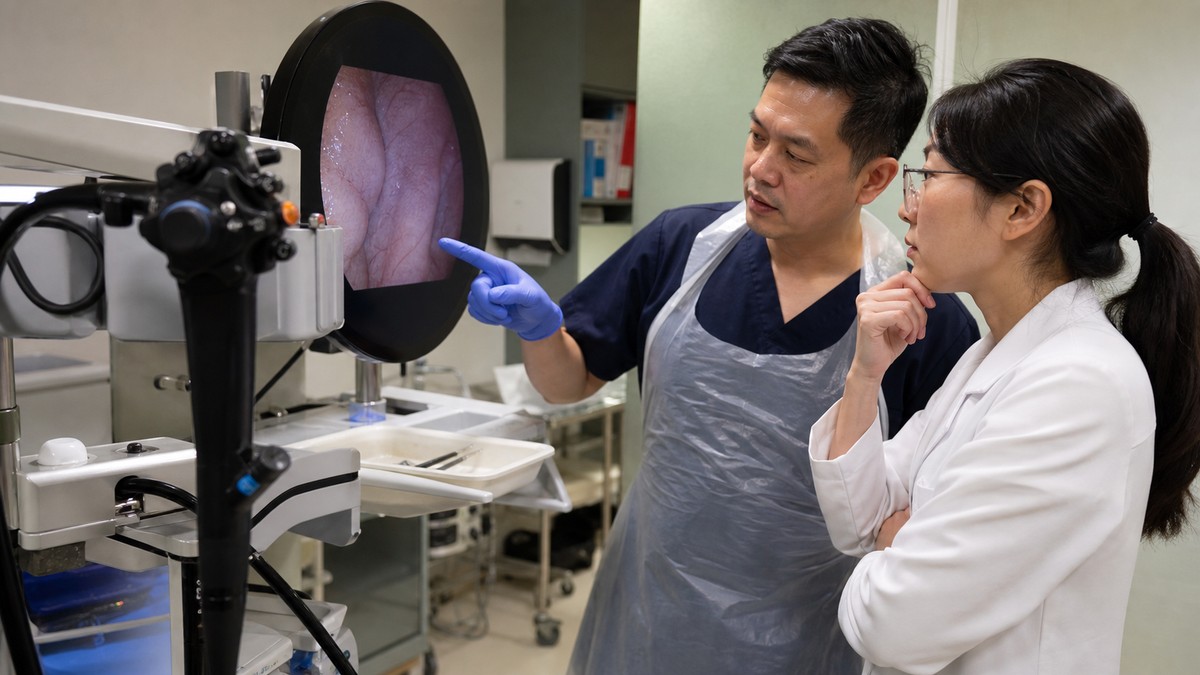
AINEX says it has agreed to supply software to Singapore’s National University Hospital (NUH) and expand joint research. The product is called Endoscopy as AI-powered Device (ENAD). It reviews video during an endoscopy and marks tissue that may need closer inspection. The company says deployment is planned across hospital endoscopy units. This is a research and implementation step; results in routine care at NUH have not been established.
The announcement also describes a trial with 998 patients at more than one medical centre. AINEX says patients were randomly assigned to standard care or care supported by its software. It reports an adenoma detection rate of 36.1 per cent in the control group and 52.3 per cent with ENAD. That rate is the share of procedures in which at least one adenoma was found. These are company-reported study figures, not results from the planned NUH use. PR Newswire
AINEX says Singapore’s Health Sciences Authority (HSA) approved the product in April 2025. Separately, HSA has described the maturity of Singapore’s medical-device regulatory system. That wider regulatory information does not endorse AINEX or the hospital project. Product approval, hospital selection and patient outcomes are different kinds of evidence. Buyers should verify the device record and read the full study before treating the reported rates as transferable. Singapore Health Sciences Authority
For hospital leaders in Southeast Asia, the commercial question starts after selection. Teams need to test whether the software works with existing endoscopy equipment and clinical routines. They should measure alert quality, procedure time, false alerts and staff acceptance. Contracts should also cover training, security, maintenance, patient data and incident reporting. A deployment without these measures can create activity without showing better care or lower cost.
The NUH project gives AINEX a reference in a respected health system. It may help other hospitals judge the product in a real operating setting. Each hospital will still need local clinical, technical and legal review. The next evidence should include the full trial publication, the final deployment scope and results from routine use. Until those are available, the strongest conclusion is that research is moving toward hospital testing. Procurement teams should also ask whether reported gains remain after training, workflow changes and local patient differences are considered.
What we checked
The company announcement supports the company-specific facts above. The official or independent link provides the separate context described in the article. The buyer questions and regional implications are SEA Connect analysis, not claims made by either source.