
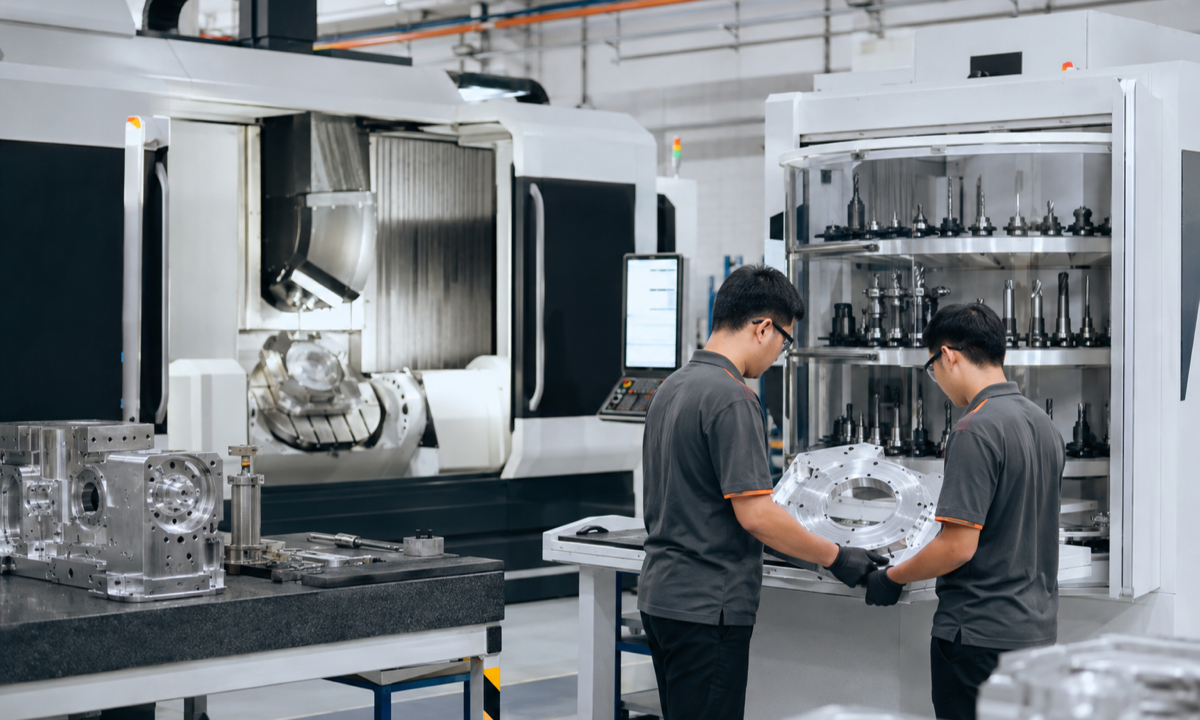
SkyGate NHJ Technology opened a 36,000-square-foot manufacturing facility in Penang’s Perai Free Industrial Zone on 4 September. The joint venture combines Penang-based SkyGate Solutions’ local operating base with Singapore-based New Jin Hai’s precision-engineering experience. MIDA says the plant supports digitalised CNC manufacturing, automation and advanced horizontal and five-axis machining. The opening establishes a physical production site, not merely an intention to explore one.
Bernama says the company plans to invest US$30 million in two phases. The first US$15 million is intended for automated five-axis production, horizontal machining centres with central tool storage and multitask turning and milling equipment. A second phase is expected to cover further machining and inspection automation, digital-twin technology and artificial-intelligence applications. Those future-phase elements remain company plans rather than installed, measured capabilities.
The immediate innovation-economy signal is the operating capacity already opened. Precision components sit upstream of semiconductor equipment, electronics, medical systems, optics and aerospace production. Buyers in those sectors depend on repeatable tolerances, quality control and reliable delivery. A local plant with current machining systems can shorten parts of that chain, but the announcement does not provide customer names, qualified products, order volumes or utilisation.
Penang already has a deep electronics and automated-test-equipment ecosystem. MIDA and InvestPenang position the new facility as a potential contributor to technology transfer, engineering skills and local supplier development. That is a reasonable policy objective, not a demonstrated outcome. The practical test is whether the venture awards work locally, develops Malaysian technicians and integrates with existing equipment and semiconductor companies.
For manufacturers, the plant may widen access to complex-shaped and thin-wall metal components and to production processes designed around automation. For local suppliers, opportunity will depend on procurement standards, certification and the share of work retained in Malaysia. For engineering talent, the useful evidence will be actual technical roles and training depth rather than an aggregate employment promise.
The cross-border structure also matters. A Singapore-linked partner is bringing established production knowledge into a Malaysian manufacturing base. If the operation wins regional customers, it could strengthen Penang’s role as a production and supplier hub rather than only an assembly location. The public sources do not establish how intellectual property, management control, procurement or revenues will be divided between the partners.
The US$30 million headline should therefore be treated carefully. Bernama attributes it to the company, and the timing of the second phase is not specified in the reviewed material. No audited capital-spending schedule, commissioning record or output benchmark is included. SEA Connect does not infer that digital twins or AI are in production simply because they appear in the phase-two plan.
The next proof points are customer qualification, equipment commissioning, production volumes, local supplier contracts, skilled hiring and the timing of the second investment phase. Those measures will show whether the opening creates durable advanced-manufacturing capability. For now, the defensible news is a real facility with specified machining technology and a disclosed expansion plan whose later outcomes remain unproven.
What we checked
SEA Connect checked the facility opening against MIDA and the reported investment plan against Bernama.