
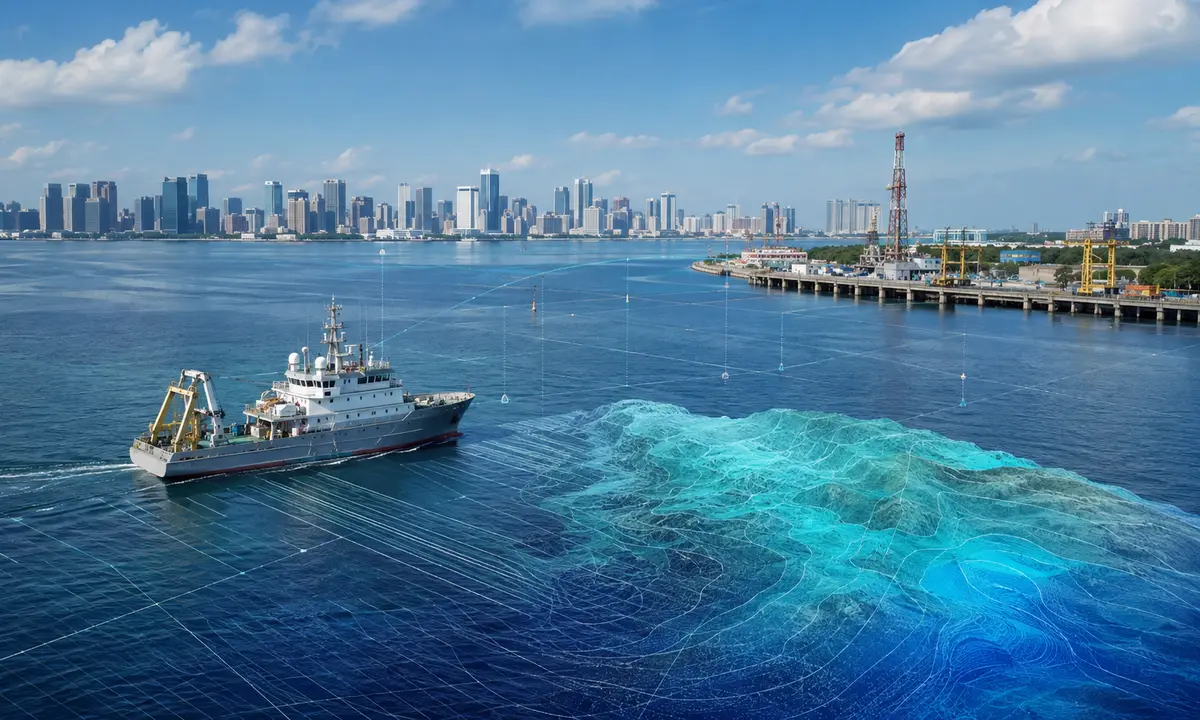
Fugro is developing an AI-driven marine digital-twin capability in Singapore, expanding the city-state’s role in the company’s Asia-Pacific Geo-data operations. The company said on 3 September that the platform is intended to combine geophysical surveys, geotechnical site investigations, laboratory results and imaging in one digital analytics environment. The announcement establishes development scope and regional intent. It does not identify a completed customer deployment, contract value or measured project saving.
The commercial problem is fragmented evidence. Offshore wind, ports, subsea cables, coastal protection and other marine projects depend on information collected at different times, resolutions and locations. Engineers must reconcile seabed conditions, soil behaviour, survey imagery and design assumptions before committing capital. A digital twin can create a shared representation of that environment, but its value depends on data quality, model validation and whether decision-makers can trace an output back to the underlying evidence.
Fugro says Singapore will act as the launchpad for regional deployment. That makes the initiative more than a local software exercise: it connects AI and digital-engineering capability in Singapore with offshore and coastal investment across Asia Pacific. If deployed commercially, the platform could support earlier risk identification and more coordinated planning. The source does not state which markets or projects will adopt it first, so those outcomes remain open.
Artificial intelligence is relevant here because marine data sets are large, uneven and expensive to collect. Models may help identify patterns, organise evidence and test scenarios across data layers. They cannot remove the need for physical investigation or accountable engineering judgement. A convincing operating model will show where automation assists interpretation, how uncertainty is represented and when a human specialist must challenge or approve a result.
Singapore’s innovation-economy role comes from concentrating regional technical capability close to project developers, financiers and infrastructure operators. Marine digital twins sit at the boundary between software and physical construction. Better information can influence design, scheduling and asset monitoring, but only when it is integrated into procurement and engineering workflows. A platform demonstration alone would not prove commercial adoption or safer project delivery.
There are important limits to the current evidence. Fugro is both the developer and the source describing the planned benefits. The announcement does not provide model-performance benchmarks, independent validation, named users, security architecture or an implementation timetable. SEA Connect therefore does not claim the capability is already reducing cost, accelerating approvals or predicting site conditions more accurately than existing methods.
Evidence to watch includes a named deployment, a defined customer operating process, independent validation of the digital representation and measured changes in survey interpretation or design decisions. Regional expansion should also be visible through project locations and repeat use, rather than ambition alone. For now, the story is a commercial marine-technology investment in Singapore that could export AI-enabled engineering capability across Southeast Asia, with operating results still to be demonstrated.
What we checked
Fugro’s dated company announcement was checked. Expected benefits are attributed to the company and no completed deployment is inferred.